
True Grit
Leigh vs. the brain tumor: Recounting a story of courage, inspiration, the goodness of the human spirit and triumph a dozen years later

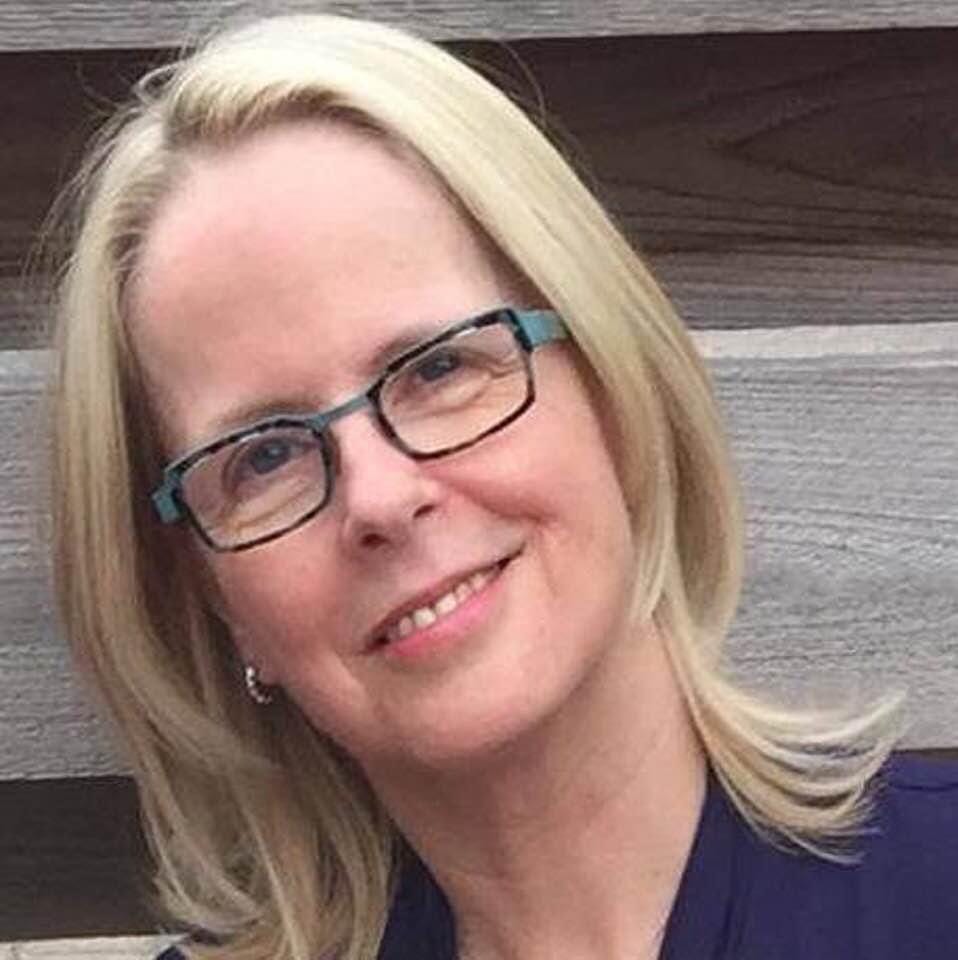
The bed shook. It shook so violently that it awoke me from an especially deep slumber. I rolled over to see Leigh, my wife of 25 years, shaking uncontrollably and sweating profusely. I grabbed her by the shoulders, tried to rouse her, screamed her name. Nothing. And then the convulsions came to a sudden stop. She fell into a deep sleep, her breathing unlabored. The episode lasted all of 45 seconds. It seemed like 45 minutes.
A smarter man would’ve called 911, but it was 4 o’clock on a Monday morning, and Steven, our 16-year-old son, was fast asleep at the other end of the hall in our two-story home in Plainsboro, N.J. My initial thought was that I didn’t want to startle him.
It was Aug. 1, 2011. The dates stick with you.
I didn’t sleep much the rest of the night, and when I got up, Leigh was already downstairs and having breakfast. I asked how she was feeling. Fine, she said. I asked if she had any recollection of what had happened in the middle of the night. No, she replied. Steven was scheduled to attend his first day of baseball camp as a counselor at his high school, and I told Leigh that after I dropped him off, I believed a trip to the doctor was in order. In the gentlest words I could muster, I told her I had witnessed something while she was sleeping. She agreed to go, although somewhat reluctantly.
And with that began a frightening yet rewarding journey: Leigh vs. the Brain Tumor, a story of courage, inspiration, the goodness of the human spirit and triumph, I called it in a “book” I presented to my bride on Christmas Eve in 2011.
It’s hard to believe a dozen years have passed since that terrifying summer night. I’ve reflected a lot over that time, and as I have often said, when I have something to share, my therapy is to write. I’ve shared our journey in social media posts and email updates over the years, but never in a single dispatch. So here we go.
The visit to the doctor turned up nothing, but he suggested a trip to the emergency room. At the time, the Princeton Hospital was an old, outdated facility. It was an especially busy day, the quarters were cramped, and the wait was excruciatingly long. A CAT scan was scheduled, and then an MRI. Steven’s day at camp was winding down, so while we awaited the test results, I made the 10-minute drive to pick him up. I didn’t leave without giving the ER doc explicit instructions: Do not share anything with my wife until I get back.
Steven was excited about his first day of camp and couldn’t wait to tell me about it. In what would become a recurring theme, I was more concerned about how much to share with him about his mother’s condition. The burning question: Exactly how much does a 16-year-old need to know?
Without being specific, I told Steven that tests were being run, and upon returning to the hospital, I left him in the waiting room while I went to check up on Leigh. I found her with an ashen expression on her face. “They think I have a brain tumor,” she said, her voice trembling.
The neurosurgeon on call soon appeared and pulled me aside to go over the MRI. Leigh had a large mass in her front-left temporal lobe. He believed it to be a low-grade tumor and probably something she had been living with for years. He recommended that Leigh be admitted to the hospital for a needle biopsy the following morning. He provided some background. I liked what I heard. I felt comfortable with the decision.
“Great,” I said. “We’ll see you in the morning.”
“Oh, no,” he said. “I won’t be doing the biopsy. My associate will handle it.”
I awoke early on Tuesday morning hoping the events of the previous day had been a bad dream, but the reality hit me when I turned over to find the other side of the bed empty. After hustling Steven off to camp, I headed for the hospital. The biopsy went off without incident, and in the post-procedure consultation, the doctor confirmed what his colleague had surmised: a low-grade tumor. The results would be back in about a week. Leigh spent another night in the hospital and was discharged the following morning.
When I encounter a crisis, my first instinct is to reach out to my older sister, Deborah. We are blessed to have such a strong relationship. But she was vacationing in Colorado, and until we got the biopsy results, there really wasn’t anything to discuss. Leigh insisted on calling Deb to tell her the news when she returned home to Dallas on Sunday. I admired her courage.
More than a week passed with no news, but on Thursday, Aug. 11, Steven and I returned from an afternoon out to find Leigh sitting in stunned silence, with that same ashen expression on her face. “The doctor called,” she said. “It’s not good.”
I was equal parts terrified and angry. Turns out the tumor was not low-grade but rather a grade 3. Malignant, too. Why had the seemingly healthy 53-year-old love of my life been dealt this hand? And why had the doctor broken the most basic ethics protocol by sharing such devastating information over the phone?
We met the following afternoon, the young doctor explaining the tumor was 4 centimeters in length and dispersed. The tumor had a name: anaplastic astrocytoma. He noted that because the mass was dangerously close to the language center, surgery would be too risky. He recommended radiation and chemotherapy to make the best of a dire situation. I asked to speak to his colleague, only to be told he was out of the office. He added the two had agreed on the course of treatment. He said to call if another doctor recommended surgery. He was adamant about it.
“With all due respect,” I said, “we’re going to get that second opinion.”
Time was of the essence, so we overnighted copies of the MRIs and the pathology report to neurosurgeons at Penn Medicine, Duke University and Sloan Kettering in New York. The response was rapid. Not a week later, we made the 45-minute drive to Philadelphia for a consultation.
“So, you’ve got a large tumor in your head and we need to get it out,” Dr. O said by way of introduction as he entered the room.
They were frightening words. They were also words we needed to hear. Dr. O was Irish through and through, and Leigh has Irish in her blood. I took that as a good omen.
Over the next 45 minutes, he spelled out in painstaking detail how everything would go: the pre-op screening, the surgery, the chemo and radiation. He sang the praises of the tumor board at Penn Medicine, which met weekly to discuss treatment and courses of action for an array of patients. He put our minds at ease. Somewhat, anyway.
Duke is home to the Tisch Brain Tumor Center, and I got the impression the folks there were eager to open Leigh’s head so they could study what was inside. That much was confirmed after Leigh decided to go with Doctor O and Penn Medicine. On the evening of Aug. 19, she got a call from the head of the department at Duke urging that she reconsider. I walked upstairs to find out to whom Leigh was talking. It was 10:45 on a Friday night. It was like she was being recruited by a couple of college football blue bloods.
Surgery was scheduled for Monday, Aug. 29 at the Hospital at the University of Pennsylvania, aka HUP. We had told some family and friends of the situation, and a dozen days before surgery, I sent an email to a larger group of friends and colleagues. Email can be so impersonal, but it had become exhausting for Leigh and me to share updates time and again, with a friend or neighbor who called in search of information and wanting to know what they could do to help. (I was running on adrenaline, and a couple of days after the initial email, my heart started to race. I bolted to the doctor and was forwarded to a cardiologist, who, much to the dismay of his staff, graciously wired me up and put me on a treadmill at 5 o’clock on a Friday afternoon. I had experienced a panic attack, it was eventually decided.) Near the end of the email, I wrote: “With things changing from hour to hour, we are on an emotional rollercoaster. Leigh has managed to keep her sense of humor through it all, noting on more than one occasion how popular she is with neurosurgeons up and down the East Coast.”
And that is what I have admired most about Leigh during this ordeal. Because of her strong faith, she kept her perspective, never lost her sense of humor, never asked, “Why me?”
But she was understandably terrified. The magnitude of the situation finally hit her during a pre-op appointment, when Dr. O’s tremendous assistant displayed a series of flash cards with images of a dog, a cat, a flower and other objects. Leigh was asked to say what she saw, and her responses were then recorded to establish a baseline for future comparison. She didn’t get three cards into exercise before she broke into tears.
Deb flew in two days before surgery. Hurricane Irene was blowing in—of course!—and her plane was one of the last to touch down before the Philadelphia airport went dark. The four of us hunkered down in a hotel a couple of blocks from the hospital. By Sunday afternoon the sun was shining brightly. The email list was growing by the hour, and that night I shared with the group something Leigh asked I pass along:
Over these past 28 days, I have experienced great irony—the frightening bad and the incredible good. The latter is because of you all.
Throughout it all, I have been afraid, confused and haunted. However, those emotions have been repeatedly trumped by the goodness and love you have all showered upon me.
Your countless acts of kindness have kept me sane during this difficult time. Please know that my heart is full and grateful because of you.
Over the past couple of weeks, I have been reading from a book of devotions titled Jesus Calling. The scripture for Aug. 29 reads in part, “Put aside all that is to be done, and refuse to worry about anything. This sacred time together strengthens you and prepares you to face whatever the day will bring.
With heartfelt thanks and all my love,
Leigh
She then decided to watch a movie before calling it a night. She picked the remake of a 1969 classic: True Grit.
Surgery was scheduled for 7:30 a.m. Steven, Deb and I were with Leigh for a few minutes during pre-op, and I asked for a minute alone. I told Leigh how much I loved her and gave her a kiss, managing to escape the room before losing it. I wondered if I would ever see her again.
The rest of the morning was, in a word, tense. We got the occasional update but little else. A couple of friends had planned to drive to Philadelphia to sit with us and provide emotional support. But the remnants of Irene (the name of the grandmother Leigh had so adored, by the way) made that impossible. Steven was a rock, but I knew he was scared. At one point, he turned to his aunt and said, “I’m glad you’re here with us.” Deb said she wouldn’t want to be anywhere else.
Dr. O and his crew came through, just as we knew they would. Surgery lasted five hours, and the first part was conducted by a neuromonitor with Leigh somewhat awake so she could respond to basic questions. (Modern medicine!) It was a critical stage, involving stimulation of the brain, identifying the language center and determining how close the tumor was to the key areas of the brain. Then Dr. O did his thing.
When it was over, we were called into a consultation room, where Dr. O delivered the wonderful news. He had been right in his diagnosis. The tumor had to come out. He estimated he had resected about 80 percent of the tumor. He didn’t leave before chatting up Steven, putting him at ease by asking about school and his baseball exploits.
Leigh was transferred to the neuro-ICU, and by 6 p.m. she seemed pretty much back to her old self. She was shown the flash cards again. Dog. Cat. Flower. There was a sense of relief, if not glee, in her tone. Dr. O detected a minor speech issue finding the right word here and there, but he was confident it would correct itself in a matter of days. And it did.
We left the hospital around 10 p.m., and as I pulled the SUV into an especially tight space in the hotel parking garage, we heard an eerie screech, the sound of metal back-left car panel meeting immovable concrete pillar. We all laughed. We needed that.
The following morning, Leigh was transferred to a private room. With minimal assistance, she walked from the bed to the wheelchair. She announced she felt so good that she didn’t see why she couldn’t head home on Wednesday. Steven volunteered to take the early morning shift, stopping at Starbucks to pick up coffee for his mother and then reading the daily devotional that was so important to her. Around lunchtime, he set out to find the best cheesesteak in town, having picked the brains of the hotel concierge and various hospital employees. We were so proud of how he was handling it all.
By Wednesday, Leigh was walking on her own. Longtime friends Denise and Mike stopped by, marveling at how good Leigh looked. I mentioned the same to Dr. O when he stopped by for the daily checkup and got choked up while thanking him for what he had done. “This is what we typically see 48 hours after surgery,” he said somewhat smugly. I took it as a subtle dig at the doctors in Durham, who had told us their care was second to none.
Leigh headed home on Thursday, not 72 hours after the completion of the surgery. But before we knew it, we were back at HUP to address seepage from the incision. She was readmitted to the same room in the same neuro-ICU on the Sunday night of Labor Day weekend. Again, her sense of humor shone through. “At least we didn’t have to drive to Duke,” she quipped.
Doctors feared an infection, perhaps even meningitis, but the problem was fixed with a suture. One lousy stitch! Leigh spent another night in the hospital under observation and was sent home the following day. Steven started his junior year of high school on Wednesday.
Leigh got the next month off, and the first of 33 radiation treatments was scheduled for Oct. 15, a Monday. It had been scheduled for the previous Thursday, but when she tried to slip into her custom Hannibal Lecter-like mask, the thing was too damn tight. Her face had swelled. It was the steroids.
Dr. M, the radiation oncologist who mapped the treatments, was every bit as brilliant as Dr. O. She told Leigh she would begin to feel the effects a couple of weeks in, and she proved to be spot-on. Leigh had begun her chemo regimen, but that was halted early on. Her blood-cell and especially her platelet counts dropped so precipitously low that doctors didn’t want her holding a sharp knife, for fear if she cut herself, she might bleed out. Thus began a series of monthly platelet transfusions that continued for more than a year. I knew it was necessary, but I grew increasingly upset as I watched my wife get repeatedly stuck with needles. Could she not catch a break? Just one! Yet I don’t remember her ever complaining.
As we went through treatment, I was struck by a couple of things. The first was the ridiculously large number of children and teenagers who were fighting their own cancer battles. It was painful enough having to watch your wife go through it, but these were kids. It didn’t seem fair. We shared a waiting room with a mother and her young daughter. They were from Cleveland. The girl was 8 years old, and they spent their “free” time at the Ronald McDonald House. So as to maintain some semblance of a family life, the father and son would drive in for the weekend. On Fridays, I would think, That little girl should be at a sleepover with friends tonight. I still wonder what happened to her.
And then there was the remarkable staff at HUP—always gracious, candid, quick to seek out a colleague when they didn’t have the answer to a question. Radiation treatments were scheduled from 6 in the morning to 10 at night. Nobody wanted to be in the basement of that hospital and there were obvious frustrations, yet I can’t remember one unpleasant experience during the countless hours we spent there. After the last treatment, I slipped an especially large tip to Rafael, a valet attendant who would magically make our car appear when Leigh was beyond exhausted and the line was around the corner. Coming and going, Rafael always greeted us with an ear-to-ear grin. “Keep doing what you’re doing,” I told him. “You’re the guy who sets the tone for everyone who pulls into this place. I can’t thank you enough.”
Leigh rang the bell on Dec. 8, 2011, a Thursday, signaling the completion of the radiation treatments. She gave the twine an extra tug or two. Friday was the day she typically got together with Denise and a half-dozen good friends for happy hour cocktails. The Friday Group, they called themselves. Leigh, of course, had missed the festivities for several months, so although it was a day early, I surprised her by bringing the gals to the Godich patio to celebrate the end of radiation. It was a spectacular, unusually warm fall afternoon. It warmed my heart to see Leigh laughing again.
My mom was like a second mother to Leigh and would have been on the first plane to New Jersey, but after suffering a debilitating stroke, she was unable to travel. We knew the end was near, so it was important for us to get to Dallas for Christmas, as we had done each of the previous seven years. One problem: Leigh’s platelet count was still low, and her oncologist didn’t want her traveling without having a doctor available. So Dr. D put in a call to her colleagues at UT Southwestern. Done. Sure enough, Leigh needed a transfusion, and she got one before we boarded the flight home. It was another in a long list of incredible gestures. We kept getting knocked over by the compassion and kindness. “Now you know you have a second doctor whenever you visit Dallas,” Dr. F told us.
Mom had endured a series of setbacks since suffering the stroke in 2004: a broken hip, a psychotic episode, urinary tract infections, you name it. But from the time we delivered the news about Leigh through early 2012, she was the picture of health. It’s like she was saying, “I’ve got to be strong for Leigh.” The first MRI post-radiation was in mid-January, and it came back clean. Deb drove to the nursing home and delivered the news. Mom died two weeks later. It’s like she was saying, “Leigh’s gonna be OK. I can go now.”
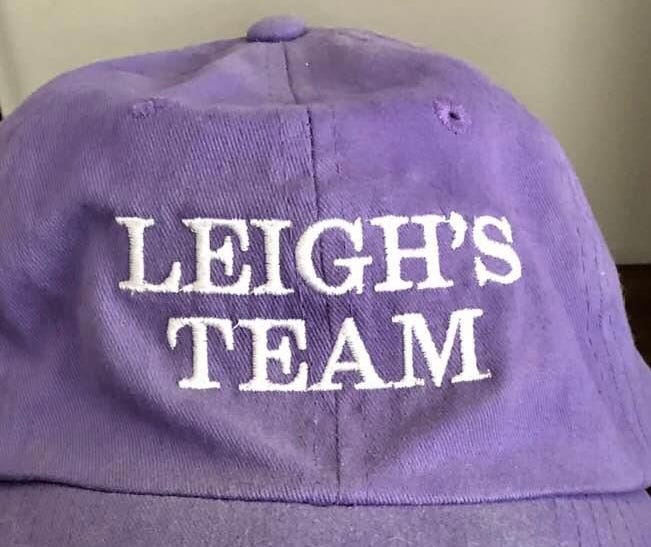
I continued with the email updates—Leigh’s Team, as the group became known, had grown to more than 150—even as she hated the attention. I didn’t care. People wanted to know. After another clean MRI in February, she saw me banging away on the keyboard. “Tell ’em I’m not sick anymore,” she said.
But we still lived with trepidation. We had been told that if the tumor made a comeback, it most likely would happen two to five years after surgery. And we didn’t have to be told what that would mean. So imagine our surprise when Dr. D walked into the room on a Tuesday morning in November 2012 with the results of the latest MRI. She believed she was seeing new tumor growth. “How can that be?” I asked. “It’s barely been a year.”
“Maybe because we had to stop the chemo,” she said. “I’m going to bounce this off of Dr. M and see what she thinks.”
She said she would get back to us on Wednesday. Of all the treks we made up and down I-95, the trip home that day was the quietest. Wednesday was a day off for me, and we both waited anxiously for the phone to ring. The call finally came a little after 9 p.m. “Dr. M thinks it’s necrosis,” Dr. D said. “Residual scarring from the radiation. I’m still not sold, but we’re going to put the MRI on the screen and discuss it when the tumor board meets tomorrow.”
I took Thursday off from work and again we waited. I reminded Leigh that she wasn’t the only sick patient at HUP and tried to reassure her that we would’ve immediately heard from the doctor if this was something serious, not that I necessarily believed it. This time the call came around 10 p.m. “The board met and we all agree it’s necrosis,” Dr. D said. “I’m sorry for taking so long to get back to you. It’s been a long day.” We embraced. Steven happened to walk into the room and asked to whom we had been talking. He was 17 now. But, again, how much does a 17-year-old need to know?
The MRIs went from monthly to every two and then three months, to semi-annually and then annually. We moved back to Dallas in the summer of 2015, but not before one last visit with Dr. D. She had been such a rock for Leigh that it was hard for us to say goodbye. I reached out to Dr. F and asked if he would take Leigh under his care. Absolutely, he responded without hesitation. Three years later, on Aug. 28, 2018, he declared Leigh cancer-free. No more MRIs. No more visits. Just keep an eye out for potential symptoms. It had been seven years since the diagnosis, which included several years of Leigh going to hell and back. This was truly a miracle. And, eerily, the news had come one day shy of the seven-year anniversary of her surgery. You always remember the dates.
Leigh still has weakness on her right side, the after-effects of the radiation. She sometimes struggles to find the right word and can be forgetful. Or maybe she’s just tuning me out! In any event, she’s as healthy as a brain-tumor survivor can be. She is my hero, and she continues to be an inspiration to so many.
And I think about this: I had a helluva run at Sports Illustrated—22 years!—and I was on staff for many of the glory years. Sunday was the longest day at the magazine, and one of the perks for those of us editors living outside New York City was a Sunday night hotel room. We’d return to the office early on Monday for the close of the magazine that night. A few of us stayed at the Marriott Marquis in the heart of Times Square, and we got to know the desk staff so well that on especially slow nights, we might be rewarded with one suite or another. On Monday we’d compare notes. Which suite did you get? (The suite to beat all suites was the two-story unit with the spiral staircase, the baby grand piano and the majestic views of the Manhattan skyline.)
When the magazine started looking to cut costs, the hotel room was among the first perks to go. Yes, business was business. Still, this meant often working until midnight or later on Sunday before heading home, then jumping back on an 8 o’clock train the next morning. The change came in early 2011. I was pissed. But later it occurred to me that if not for the policy change, I wouldn’t have been at home on that August night when the bed shook so violently. Would Leigh even be alive? At the very least, she would have awakened not knowing she had suffered a grand mal seizure.
In February 2011, six months before that fateful day, we celebrated our 25th anniversary at Ruth’s Chris. At the bar before dinner, I surprised Leigh with a diamond ring. We were on top of the world. We both felt like a scotch, and when the bartender told us he didn’t have a drink menu, I told him to pour a Johnnie Walker Blue on the rocks for each of us. We had never sipped such a fine scotch. We almost ordered a second, but our table was ready and we were planning to have wine at dinner. The bar tab arrived. I thought there was a mistake on it until I saw the JWB next to the price: $44 a pop. Still, it was money well spent.
I have told this story too many times to count, including in an email to Leigh’s Team on the evening of Nov. 10, 2011, the night of Leigh’s 54th birthday, after another trip to Ruth’s Chris. Amid all the treatment and chaos that fall, Leigh and I had signed up for the Race for Hope, a 5k walk/run in Philadelphia to benefit the National Brain Tumor Society. We invited friends and family to join us, and to donate to the cause if they felt so inclined. And in the three weeks leading up to the Nov. 6 event, our little grass-roots campaign raised $13,587, seventh-best among the 371 registered teams. (The following year, we raised another $30,000 plus.) We were joined by 20 friends, each decked out in a purple “Leigh’s Team” hat, a gift that had been arranged by a work colleague. Everyone also sported purple bracelets inscribed with “Leigh’s Team.” That was Steven’s idea. He gave the bracelets to anybody who so much as asked how his mother was doing.
It was the countless gestures that kept Leigh and Steven and me going. I can’t begin to estimate how many hot meals were delivered to the house, how many friends signed up for a shift driving Leigh to a radiation treatment, how many offered to take her to a movie or to get her hair done or to do whatever her heart desired.
I started that November email with the following:
Where to begin? Over these past three months, I have learned more about brain tumors than I could have ever imagined. It is fascinating stuff. Among other things, I have learned about anaplastic astrocytomas and neuromonitoring, about the insular lobe and proton radiation. Google has become my friend. Now I have witnessed something even more fascinating, something you can’t find on web sites or in medical journals. It has to do with the goodness of the human spirit.
I provided a medical update—Leigh had hit hump day on the 33 radiation treatments—and shared the Johnnie Walker Blue anecdote. I mentioned the ridiculous amount of money that Leigh’s Team had raised for brain tumor research. And I closed with this:
The JWB is packaged in a slim, velvet-lined box. It is stored in the back of the liquor cabinet and reserved for special occasions. Tonight I will break out the JWB. I will reflect on another period in time I will never forget. And I will offer a toast to you.
It would be the 13th of 14 email updates I included in the book I presented to Leigh that Christmas, Mom’s last. I knew she would remember little about her ordeal, and I hoped it would remind her what an inspiration she is. The book is 47 pages long and with the handful of replies I included at the end of each entry, the word count exceeded 16,000. I still thumb through it occasionally, but never without getting choked up. One reply to the 13th email came from a colleague who eloquently wrote:
Here’s hoping that the military nouns keep softening for you and Leigh. From war to battle to skirmish to encounter.
In fact, we have reached the encounter phase in this 12-year odyssey. We count our blessings every day. I’m not going to lie: When you hear “two to five years,” you start setting short-term goals and contemplating the worst. In our case, the first goal was for Leigh to see Steven walk across the high school graduation stage in 2013. And then the college graduation stage in 2017. And now here Leigh is, determined and working as hard as ever to keep her right leg strong, in anticipation of walking down the aisle at Steven and Madeline’s wedding next spring. And so she can cut a rug with her son at the reception.
Yes, there will be dancing. Johnnie Walker Blue, too.
What a story. God bless you guys. Never take anything for granted.
I don't know who you are but the love you have for your wife (and the wonderful person she is) shines through. I'm crying reading this. God bless you all and you are all in my prayers.